
Kutch Rann Utsav: 15 Best Places to Visit in White Desert, Bhuj, Dholavira & Complete Travel Guide
Kutch Rann Utsav: 15 Best Places to Visit in White Desert, Bhuj, Dholavira & Complete Travel Guide — Quick Traveler Dossier
Destination Overview & Historical Heritage
Spanning an astounding 45,674 square kilometers of pristine salt flats, rugged basalt volcanic hills, ancient Harappan ruins, and timeless pastoral hamlets, Kutch is India’s largest district and one of the most mesmerizing travel frontiers on the planet. Its crowning jewel is the Great Rann of Kutch—a colossal 7,500-square-kilometer seasonal salt marsh that transforms every winter into a dazzling, infinite expanse of pure white crystalline salt shimmering beneath the limitless azure sky.
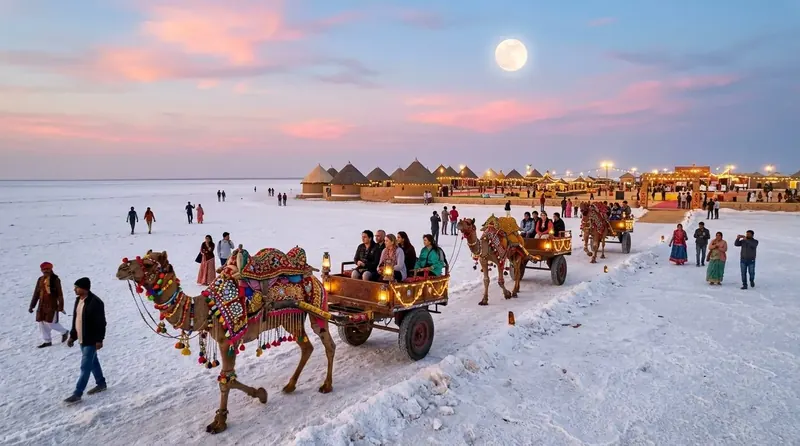
Celebrated globally through the annual four-month extravaganza known as Rann Utsav (organized from November through February at the tent village of Dhordo), Kutch offers an otherworldly experience where culture, folk music, and pristine nature meet in sublime harmony. To witness the surreal silver glow of the White Desert under the celestial luminescence of a winter full moon—with traditional Kutchi instruments like the Bhorrindo, Surando, and Jodiya Pawa echoing across the quiet dunes—is an emotional experience that touches the deepest core of the human spirit.
Yet, Kutch is profoundly more than its poetic salt flats. In the interior lies the historic royal capital of Bhuj, with its European-influenced 18th-century palaces like the Aina Mahal and Prag Mahal. To the north rises the prehistoric island of Khadir Bet, home to Dholavira, inscribed as a UNESCO World Heritage Site in 2021 as one of the world's most sophisticated Bronze Age Harappan urban metropolises. Along the southern coastline lies Mandvi, famous for its 400-year-old wooden shipbuilding yards and the royal Vijay Vilas Palace.
Perhaps most extraordinary of all is Kutch's living artisan heritage. Across artisan villages like Nirona, Bhujodi, and Ajrakhpur, master craft families continue ancient artistic traditions—such as castor-oil Rogan painting, copper bell making, intricate bandhani tie-dye, and vibrant camel-wool weaving—preserving a culture where every household is a sanctuary of living folk art.
Top Places to Visit & Major Attractions
1. The White Desert of Dhordo & Rann Utsav Tent City
Location & Significance: Dhordo Village, 85 km north of Bhuj
The epicentre of the Kutch tourism experience is the world-famous White Desert at Dhordo. As the monsoon floodwaters recede in October, intense desert sunshine evaporates the briny marsh, depositing millions of tons of pure crystalline salt across an endless flat horizon. During Rann Utsav, the Gujarat Tourism Department erects a luxurious pop-up city of over 400 premium Swiss luxury tents and royal villas known as Tent City.
Visitors can take camel-cart rides onto the salt flats, ride desert paramotors and all-terrain vehicles (ATVs), and watch breathtaking sunsets where the golden solar disc dissolves into a purple horizon. The absolute pinnacle of the experience occurs during the three nights surrounding the Full Moon (Purnima), when the salt crystals reflect lunar light with an ethereal silver luminescence that creates the illusion of walking across an endless frozen lake beneath the stars.
2. Dholavira (UNESCO World Heritage Harappan Metropolis)
Location & Significance: Khadir Bet Island, Great Rann of Kutch (210 km from Bhuj)
Inscribed as a UNESCO World Heritage Site in 2021, Dholavira is one of the five largest and most impeccably preserved urban centers of the ancient Indus Valley Civilization (flourishing between 3000 BC and 1500 BC). Unlike brick cities like Mohenjo-daro and Harappa, Dholavira was constructed entirely from dressed sandstone blocks, showcasing a monumental tripartite city plan consisting of a fortified Citadel, a Middle Town, and a Lower Town.
The engineering marvel of Dholavira lies in its sophisticated hydraulic water management system: sixteen interconnected massive stone-cut reservoirs and subterranean storm-water drains capable of storing 250,000 cubic meters of fresh water in a hyper-arid desert. Visitors can also observe the world's oldest signboard—ten colossal Harappan pictographic characters carved from gypsum crystals—and the world's oldest stone sports stadium and ceremonial parade ground.
3. The Road to Heaven (National Highway 754K)
Location & Significance: Connecting Khavda to Dholavira across the Great Rann
One of the most breathtaking highway drives in the world, the 30-kilometer newly constructed "Road to Heaven" bisects the open salt flats of the Great Rann, connecting Khavda on the mainland directly to Khadir Bet island. Driving along this elevated four-lane tarmac gives the surreal, heart-pounding sensation of gliding across an infinite ocean of sparkling white salt, with shimmering optical mirages dancing on either side under the brilliant desert sun.
4. Kalo Dungar (Black Hill) & Dattatreya Temple
Location & Significance: Highest point in Kutch (462 meters), 25 km north of Khavda
Rising as the highest geological peak in Kutch, Kalo Dungar offers an unmatched panoramic vista overlooking the northern expanse of the Great Rann, where white salt flats merge into the international border with Pakistan. The summit houses the 400-year-old temple of Lord Dattatreya, where priests perform a timeless daily ritual of feeding vegetarian cooked rice and lentils to packs of wild golden jackals who emerge peacefully from the scrub forest at sound of a ceremonial gong.
Nearby lies the fascinating Magnetic Hill optical anomaly, where vehicles placed in neutral appear to roll uphill against gravity due to surrounding horizon gradients.
5. Bhuj Heritage City (Aina Mahal, Prag Mahal & Bhujia Fort)
Location & Significance: Central Kutch District Capital
The royal capital of Bhuj is steeped in princely history. The 18th-century Aina Mahal (Palace of Mirrors), created by the legendary artisan Ram Singh Malam who trained in Europe, features Venetian glass mirrors, Dutch tiles, and a floating floor of water fountains. Adjacent stands the majestic 19th-century Prag Mahal, built in Italian Gothic style featuring an imposing 45-meter clock tower with panoramic city views.
Overlooking the city is the serpentine rampart of Bhujia Fort, home to the Bhujang Nag temple and the newly inaugurated, deeply moving Smritivan Earthquake Memorial & Museum on Bhujiyo Hill—a world-class architectural complex dedicated to the resilience of Kutch following the 2001 earthquake.
6. Artisan Craft Villages (Nirona, Bhujodi & Ajrakhpur)
Location & Significance: Craft clusters within 40 km of Bhuj
Kutch is a global Mecca for traditional textiles and handcrafted arts. In Nirona village, the Khatri family preserves the world's only surviving lineage of Rogan Art—an ancient technique where boiled castor oil paste mixed with natural earth pigments is painted onto fabric using a blunt metal stylus without the stylus ever touching the cloth.
Nirona is also famous for handmade copper tuning bells and vibrant lacquer woodcraft. In nearby Bhujodi, master Vankar weavers craft exquisite wool and tussar silk shawls on pit looms, while Ajrakhpur showcases the 16-step natural indigo and pomegranate-rind block-printing art of Ajrakh.
7. Mandvi Coastal Port & Vijay Vilas Palace
Location & Significance: Arabian Sea coast, 60 km south of Bhuj
The historic maritime port of Mandvi is celebrated for its 400-year-old traditional wooden shipbuilding yards (Botiya industry) along the Rukmavati River, where master craftsmen assemble ocean-going dhows without blueprints. A short drive away on a private coastal estate stands the majestic Vijay Vilas Palace, built in 1929 by Rao Vijayrajji out of red sandstone, featuring ornate marble jharokhas, royal gardens, and a pristine private beach famed as a filming location for numerous Bollywood blockbusters.
Suggested Day-by-Day Travel Itinerary
| Day | Focus Area | Recommended Plan & Activities |
|---|---|---|
| Day 1: Arrival & White Desert Sunset | Bhuj to Dhordo Tent City | Morning arrival at Bhuj. Drive 85 km north to Dhordo Tent City. Check-in and explore the handicraft haat. 4:30 PM camel cart ride into the White Rann to witness the sunset over the salt flats. Evening cultural folk dance and Kutchi music at Tent City under starry skies. |
| Day 2: Kalo Dungar & Full Moon Experience | Highest Peak & Lunar Illumination | Morning drive to Kalo Dungar (Black Hill) for panoramic border views and the Jackal ritual. Experience the Magnetic Hill. Afternoon rest at Dhordo. Post-dinner 10:00 PM walk onto the White Desert to experience the silver radiance of the Full Moon. |
| Day 3: Road to Heaven & Dholavira Harappan Wonder | UNESCO World Heritage Expedition | Early 6:30 AM departure along the spectacular 30 km "Road to Heaven" across the Great Rann to Dholavira. Comprehensive guided tour of the Harappan Citadel, monumental stone water reservoirs, and excavation museum. Evening return to Bhuj. |
| Day 4: Royal Palaces, Artisan Villages & Departure | Palaces & Master Craft Heritage | Morning tour of Aina Mahal, Prag Mahal, and Smritivan Museum in Bhuj. Afternoon excursion to Nirona for Rogan art and Bhujodi for handloom weaving before departure from Bhuj airport or railway station. |
Local Cuisine, Street Food & Cultural Experiences
The gastronomy of Kutch reflects the resilience and ingenuity of desert communities. A beloved street food staple originating in Mandvi and Bhuj is the authentic Kutchi Dabeli—spiced potato mash blended with a proprietary blend of aromatic spices, roasted peanuts, pomegranate seeds, and tangy tamarind chutney, toasted in fresh pav with pure butter. Travelers must also savor Kutchi Kadhi-Khichdi cooked with local millets, fiery Lasan ni Chutney, and freshly made Kutchi Gulab Pak (a rich confection made with almond flour, pure ghee, and rose petals).
For dairy lovers, the camel milk products from Kutch's pastoral Maldhari co-operatives—including camel-milk ice creams, chocolates, and fresh mawa sweets—provide a rare culinary delight. Culturally, night gatherings in the desert ring out with soul-stirring Sufi and Bhakti poetry sung by village bards playing the single-stringed Ektara and double-flute Jodiya Pawa, celebrating themes of spiritual unity and timeless love.
How to Reach, Transportation & Local Transit
Travelers accessing Kutch can utilize convenient rail, air, and road connections. By air, Bhuj Airport (BHJ) operates regular commercial flights connecting Mumbai and Ahmedabad. Alternatively, Kandla Airport (IXY) near Gandhidham (60 km from Bhuj) provides additional scheduled flights. Taxis, state luxury buses, and tour coaches operate extensively from the airport across all major circuits.
By rail, Bhuj Railway Station (BHUJ) is a major terminal connecting with daily superfast expresses to Mumbai (Kutch Express, Sayajinagari Express), Ahmedabad (Vande Bharat Express), Delhi, and Kolkata. By road, national highways NH 341 and NH 41 provide excellent tarmac quality, connecting Ahmedabad to Bhuj within 6 hours of smooth expressway driving. Private taxi rentals and organized luxury coach tours are the most convenient mode for exploring the vast distances between Dhordo, Dholavira, and Mandvi.
Best Season to Visit & Climate Guide
The premier travel season for Kutch is strictly during the winter months from November through February, aligning with the official duration of Rann Utsav. During this window, crisp desert winds keep daytime temperatures between a pleasant 22°C and 28°C, while night temperatures drop to an invigorating 8°C to 12°C, making bonfire evenings and moonlit desert walks enchanting.
The three nights of each month surrounding the Full Moon (Purnima) represent peak demand, with tent cities and hotels often booked months in advance. Summer months (April to June) bring scorching desert heat exceeding 44°C, while the monsoon season (July to September) submerges the salt flats under briny sea-water, closing the White Desert to tourism until the waters evaporate in late autumn.
Essential Travel Tips, Timings & Entry Regulations
1. Mandatory Rann Permit: Due to proximity to the international border, visiting the White Desert at Dhordo requires a government permit. Permits can be obtained easily online at the official portal (www.rannpermit.gujarat.gov.in) or at the Bhirandiyara police checkpoint by showing original government photo IDs.
2. Book Full Moon Dates in Advance: If you wish to witness the White Rann under a full moon, check lunar calendar dates and book tent accommodation or Bhuj hotels at least 2 to 3 months in advance.
3. Winter Clothing: Desert nights get intensely cold; pack warm jackets, thermal innerwear, woolen caps, and shawls for evening camel cart rides and night desert walks.
4. Road to Heaven Drive: Fill fuel tanks at Khavda before heading across the 30 km Road to Heaven towards Dholavira, as fuel stations on Khadir Bet are limited.
5. Respect Artisan Spaces: In craft villages like Nirona and Bhujodi, artisans welcome travelers into their family workshops; please ask permission before recording videos of delicate family techniques, and support artisans by purchasing directly from their workshops.
Frequently Asked Questions
Q1: What is Rann Utsav and when is it celebrated?
Rann Utsav is a 4-month cultural carnival organized by Gujarat Tourism at Dhordo in the Great Rann of Kutch, running annually from early November to late February.
Q2: Why does the desert turn white in Kutch?
During monsoon, sea water and river runoffs submerge the low-lying basin. As water evaporates under intense winter sunshine, thick crystallized white salt crusts form across thousands of square kilometers.
Q3: How do I obtain a permit to visit the White Desert?
Permits can be applied for online at rannpermit.gujarat.gov.in or in person at the Bhirandiyara check-post by presenting a valid government photo ID and paying a nominal fee.
Q4: What makes Dholavira an important UNESCO World Heritage Site?
Inscribed in 2021, Dholavira is an extraordinary 4,500-year-old Harappan metropolis famous for its monumental dressed stone architecture, sophisticated water conservation reservoirs, and the world's oldest inscription signboard.
Q5: What is the "Road to Heaven" in Kutch?
The "Road to Heaven" is a stunning 30 km stretch of National Highway 754K slicing straight through the shimmering white salt flats of the Great Rann, connecting Khavda to Dholavira.
Q6: What is Rogan Art and where can I see it?
Rogan Art is an ancient painting technique using boiled castor oil paste and mineral pigments, preserved exclusively by the Khatri family in Nirona village near Bhuj.
Q7: How many days are recommended for a complete Kutch itinerary?
A 4-day / 3-night or 5-day / 4-night itinerary is recommended to thoroughly explore Dhordo White Desert, Kalo Dungar, Dholavira, Bhuj heritage monuments, and artisan craft villages.
INSIDZ Travel Verdict & Why You Must Visit
The Great Rann of Kutch is an ethereal, spellbinding wonderland unlike anywhere else on earth. From the surreal silver radiance of the White Desert under a full moon to the ancient stone water reservoirs of Harappan Dholavira and the legendary warmth of Kutchi artisans, it is an essential life journey that will remain etched in your soul forever.

Laptop Keyboard
⚡ 60 મિનિટમાં કીબોર્ડ ફિટિંગતમામ મોડેલ્સના કીબોર્ડ • ઘરે 60 મિનિટમાં ફિટિંગ • ₹0 વિઝિટિંગ ચાર્જ
Published by INSIDZ Admin
સંબંધિત સમાચારો & વધુ વાર્તાઓ (RECOMMENDED READS)
 પ્રવાસન
Statue of Unity: 15 Best Places to Visit in Ekta Nagar Kevadia, Viewing Gallery & Complete Travel Guide
10 min readવાંચો → પ્રવાસન
Gir National Park Lion Safari & Somnath Temple: 12 Best Places to Visit & Wildlife Guide
10 min readવાંચો → પ્રવાસન
Dwarka & Sudarshan Setu: 10 Best Places to Visit, Bet Dwarka, 52-Gaj Dhwaja & Complete Pilgrimage Guide
9 min readવાંચો → પ્રવાસન