
Rani Ki Vav & Modhera Sun Temple: The Ultimate Patan Heritage, Patola Silk & Stepwell Travel Guide
Rani Ki Vav & Modhera Sun Temple: The Ultimate Patan Heritage, Patola Silk & Stepwell Travel Guide — Quick Traveler Dossier
Destination Overview & Historical Heritage
Nestled in the historic plains of North Gujarat, the twin heritage sanctuaries of Patan and Modhera embody the absolute zenith of medieval Indian architectural grandeur, subterranean engineering, and sublime artistic craftsmanship. Flourishing under the illustrious Solanki dynasty (the Chalukyas of Gujarat, 10th to 13th centuries AD)—revered in Indian history as the "Golden Age of Gujarat"—this region produced monuments so breathtaking in scale and delicate in sculptural detail that they command universal awe today.
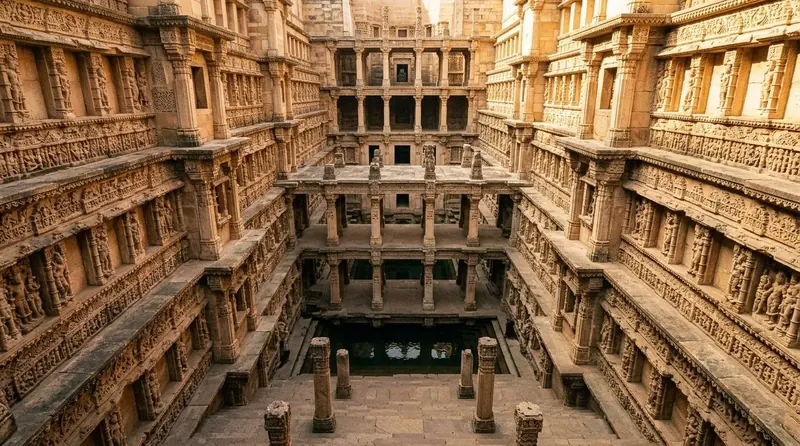
Chief among these treasures is Rani Ki Vav (The Queen's Stepwell) in Patan, recognized by UNESCO in 2014 as an exceptional World Heritage Site and immortalized on the reverse side of the Reserve Bank of India’s new ₹100 banknote. Commissioned around 1063 AD by Queen Udayamati as an enduring memorial to her departed husband King Bhima I, this inverted subterranean temple plunges seven levels into the earth, covered in over 800 monumental sculptures celebrating divine preservation and cosmic balance.
Just 35 kilometers south along the banks of the sacred Pushpavati River stands the architectural symphony of the Modhera Sun Temple. Designed with sublime astronomical precision so that the rays of the rising sun illuminated the golden idol of the Sun God Surya during the equinoxes, Modhera remains an unmatched masterpiece of Maru-Gurjara temple architecture, featuring a massive stepped reservoir (Surya Kund) lined with 108 miniature shrines.
Complementing this stone poetry is the living heritage of Patan Patola, the legendary double-ikat silk weaving tradition where a single saree requires up to six months of painstaking mathematical calculation, natural dye extraction, and master handloom weaving. Together, Patan and Modhera present a peerless cultural odyssey that takes travelers back into the majestic courts of medieval India.
Top Places to Visit & Major Attractions
1. Rani Ki Vav (The UNESCO World Heritage Queen’s Stepwell)
Location & Significance: Patan City, 125 km north of Ahmedabad
Built as an inverted subterranean temple dedicated to the sacred sanctity of water, Rani Ki Vav measures 64 meters in length, 20 meters in width, and plunges 27 meters deep across seven pillared terrace storeys. Unlike standard secular stepwells, the architecture here was conceived as an ode to Lord Vishnu, the preserver of the universe, featuring more than 500 principal sculptures and over 1,000 secondary mythological reliefs.
As visitors descend into the cool depths of the stepwell, the stone walls reveal the ten incarnations (Dashavatara) of Vishnu carved with razor-sharp precision out of hard golden-yellow sandstone. Highlights include the magnificent panel of Sheshashayi Vishnu resting gracefully upon the serpent Shesha amidst the cosmic ocean, accompanied by dancing celestial nymphs (Apsaras) applying eyeliner, braiding hair, and displaying 16 ornamentation styles (Solah Shringar).
2. Modhera Sun Temple (Surya Mandir)
Location & Significance: Modhera Village, Mehsana District (35 km from Patan)
Constructed in 1026–27 AD under King Bhima I, the Modhera Sun Temple is an architectural triumph dedicated to the solar deity Surya. The monument complex is divided into three harmonious axial components: the Guda Mandapa (the sanctum sanctorum), the Sabha Mandapa (the assembly hall of 52 intricately carved pillars representing the 52 weeks of the solar year), and the majestic Surya Kund (stepped water reservoir).
The astronomical engineering of the temple is legendary: during both the vernal and autumnal equinoxes, the first rays of the dawn sun pierced through the carved pillared corridors to illuminate the bejeweled forehead of the Sun deity inside the sanctum. The exterior walls are blanketed in bas-relief panels depicting solar deities, cosmic planetary spheres, episodes from the Ramayana and Mahabharata, and vibrant facets of contemporary 11th-century everyday life.
3. Surya Kund (Rama Kund Stepped Tank)
Location & Significance: Directly in front of the Modhera Sun Temple assembly hall
The rectangular Surya Kund is universally celebrated as one of the most aesthetically balanced stepped reservoirs in the world. Descending down intricate geometric pyramids of stone steps, the tank houses 108 miniature carved shrines dedicated to Ganesha, Shiva, Vishnu, and various incarnations of Goddess Durga. The hypnotic geometric symmetry of the steps reflecting across the calm surface of the water provides an unforgettable feast for photographers and heritage lovers.
4. Patan Patola Heritage Museum & Salvi Master Weavers
Location & Significance: Near Rani Ki Vav, Patan Town
The historic town of Patan is world-renowned as the cradle of Double-Ikat Patola Silk, an ancient weaving technique protected by Geographical Indication (GI) status. In double-ikat, both the warp and weft threads are individually dyed using natural vegetable colors before being mounted on traditional wooden handlooms, ensuring that both sides of the woven fabric exhibit identical color vibrancy and geometric precision.
At the Patola Heritage Museum, run by the master artisan family of Salvis who have preserved the craft for over 35 generations since being invited to Patan by King Kumarapala in the 12th century, visitors can witness live handloom weaving demonstrations. A genuine authentic Patan Patola saree requires four to six months of collective labor and can last for over three hundred years without fading, giving rise to the famous Gujarati proverb: "The fabric may tear with age, but the color and pattern will never fade."
5. Sahasralinga Talav & Historical Excavations
Location & Significance: Northwestern outskirts of Patan along the old Saraswati River bed
Commissioned by the legendary Solanki ruler Siddhraj Jaisinh in the early 12th century, Sahasralinga Talav was an extraordinary medieval hydraulic engineering project consisting of a massive artificial reservoir fed by canal waters diverted from the sacred Saraswati River. The perimeter of the reservoir was historically adorned with one thousand small Shiva lingam shrines and colonnaded pavilions.
Today, visitors can explore the excavated stone sluice gates, octagonal stone siltation basins, intricately carved inlet channels, and the adjacent medieval monuments including the Bahlol Khan Ghazi Dargah and ancient stepwells that demonstrate medieval Gujarat’s world-leading mastery over water conservation.
6. Bindu Sarovar & Matru Gaya Kshetra
Location & Significance: Siddhpur Town, 28 km east of Patan
Often called the "Varanasi of Gujarat," nearby Siddhpur is the site of Bindu Sarovar, the only sanctified pilgrimage spot in India where the ancient ritual of Matru Shradh (ancestral rites honoring departed mothers) is conducted, as performed by the sage Parashurama. The town is equally celebrated for its surreal collection of Victorian-era pastel European Bohra mansions (Vohrawads) featuring ornate wooden facades, stained glass windows, and Corinthian columns that transport visitors to 19th-century Europe.
Suggested Day-by-Day Travel Itinerary
| Day | Focus Area | Recommended Plan & Activities |
|---|---|---|
| Day 1: Ahmedabad to Modhera & Patan | Sun Temple & Subterranean Poetry | Morning drive from Ahmedabad to Modhera (2 hours). Explore Modhera Sun Temple and Surya Kund. Afternoon drive to Patan. Guided tour of UNESCO World Heritage Rani Ki Vav. Evening visit to Patola Heritage Museum to witness double-ikat weaving. |
| Day 2: Patan Monuments & Siddhpur Heritage | Ancient Hydraulic Tanks & Victorian Pols | Morning walk across Sahasralinga Talav excavations. Short drive to Siddhpur to photograph the European-style Bohra wooden mansions and visit Bindu Sarovar. Relish traditional Gujarati Farsan in Mehsana before evening drive back to Ahmedabad. |
Local Cuisine, Street Food & Cultural Experiences
Exploring North Gujarat is incomplete without indulging in its distinctive regional gastronomic heritage. Patan is famed across the state for its signature sweet: Devda, a crisp, layered wheat confection gently caramelized in pure sugar syrup that has been prepared by local confectionery masters for over two centuries. Visitors must also sample Patan’s distinctive Khaman and spiced chickpea Fafda paired with spicy green chili chutney.
In nearby Mehsana and Modhera, travelers are welcomed with hearty rural meals centered on freshly roasted Bajra no Rotlo slathered in fragrant homemade white butter (Makhan), accompanied by robust garlic chutneys, stuffed Tindora nu Shaak, smoked Ringan no Olo, and refreshing tumblers of fresh cow-milk buttermilk. The local handicrafts markets offer wooden block prints, brass temple lamps, and authentic Mashru textile fabrics—a unique woven blend of pure silk exterior and comfortable cotton lining historically favored by royal patrons.
How to Reach, Transportation & Local Transit
Patan and Modhera are easily accessible via well-maintained multi-lane expressways. The nearest major air hub is Sardar Vallabhbhai Patel International Airport (AMD) in Ahmedabad, situated 115 km south with round-the-clock domestic and international flight connections. Taxis, self-drive rentals, and air-conditioned state transport buses connect Ahmedabad to Patan within 2.5 hours of smooth driving.
For rail passengers, Mehsana Junction (MSH) serves as the primary railway node, positioned just 35 km from Modhera and 45 km from Patan, with frequent superfast trains connecting Delhi, Mumbai, Jaipur, and Ahmedabad. Patan also has its own dedicated broad-gauge railway station (PTN) with passenger services connecting Mehsana and Bhuj. Local transport between sights is readily managed through auto-rickshaws, app-based cabs, and dedicated heritage tour coaches.
Best Season to Visit & Climate Guide
The optimal window to experience the architectural wonders of Patan and Modhera is during the cool winter months from October through March. Daytime temperatures hover between a pleasant 18°C and 27°C, allowing visitors to leisurely photograph the intricate stone carvings without fatigue from desert heat.
A premier highlight of the winter calendar is the annual Uttarardh Mahotsav (Modhera Dance Festival) held every January over three enchanting nights. Hosted by Gujarat Tourism against the illuminated stone backdrop of the Sun Temple and Surya Kund, the festival brings together classical dancers, Kathak maestros, and Bharatnatyam virtuosos from across India, creating an unforgettable spectacle of living art amidst medieval stone architecture.
Essential Travel Tips, Timings & Entry Regulations
1. Photography Timings: For optimal lighting at Modhera Sun Temple and Surya Kund, arrive at sunrise (6:30 AM to 8:00 AM) when the golden morning rays highlight the eastern facade. For Rani Ki Vav, midday between 11:30 AM and 2:00 PM provides direct sunlight into the lower subterranean tiers.
2. Footwear Regulations: Walking inside Rani Ki Vav involves climbing down stone stairs; wear comfortable walking shoes with good grip. Modhera Sun Temple requires removing shoes before stepping onto the temple plinth and assembly hall.
3. Official Guide Services: Certified ASI guides are available at the entrance of both Rani Ki Vav and Modhera; hiring a knowledgeable guide is strongly recommended to decode the complex iconography and astronomical alignments.
4. Patola Saree Authenticity: Authentic double-ikat Patola sarees cost upwards of ₹1.5 Lakh due to months of handloom labor; purchase only from recognized Salvi family workshops or verified GI-tagged heritage outlets.
5. Combined Day Excursion: Travelers based in Ahmedabad can comfortably cover Modhera, Patan, and Siddhpur as a single comprehensive day excursion by departing early morning around 7:00 AM.
Frequently Asked Questions
Q1: Why is Rani Ki Vav considered an exceptional UNESCO World Heritage Site?
Rani Ki Vav was built in the 11th century as an inverted subterranean temple rather than a mere water well. It showcases over 500 major sculptures and seven terrace levels, representing the pinnacle of Maru-Gurjara subterranean architecture.
Q2: What is unique about the design of the Modhera Sun Temple?
The temple was engineered with solar astronomical precision so that during the equinoxes, the rising sun illuminated the golden idol inside the sanctum. Its Surya Kund stepped reservoir with 108 miniature shrines is a masterclass in geometric balance.
Q3: What makes Patan Patola sarees so famous and valuable?
Patan Patola is an ancient double-ikat silk weaving tradition where both warp and weft threads are individually dyed before weaving. A single saree requires up to six months of labor by master weavers and retains its color and durability for centuries.
Q4: How far are Patan and Modhera from Ahmedabad?
Modhera is approximately 95 km north of Ahmedabad (2-hour drive), and Patan is located another 35 km further north. Both destinations can be easily explored in a day trip or an overnight weekend itinerary.
Q5: When does the Modhera Dance Festival take place?
The Uttarardh Mahotsav Modhera Dance Festival is held annually in the third week of January, featuring classical Indian music and dance performances set against the illuminated ancient temple.
Q6: What local sweet is Patan famous for?
Patan is celebrated for "Devda," a traditional multi-layered sweet delicacy prepared using wheat flour, pure ghee, and caramelized sugar syrup that has been cherished for over two centuries.
Q7: Can visitors go down to the lowest level of Rani Ki Vav?
Visitors can walk down the first few terrace levels along designated stone corridors, while the lowest water cistern levels are protected by protective railings maintained by the Archaeological Survey of India (ASI) for structural conservation.
INSIDZ Travel Verdict & Why You Must Visit
Rani Ki Vav and Modhera Sun Temple stand as timeless testaments to the creative genius and spiritual devotion of medieval Gujarat. A journey across these sunlit monuments and subterranean marvels is an absolute must-visit pilgrimage of wonder for every traveler.

Laptop Battery
⚡ ૧ વર્ષ પૂરી વોરંટીબધી બ્રાન્ડની ઓરિજિનલ બેટરી • ૧ વર્ષ પૂરી વોરંટી • ₹0 વિઝિટિંગ & ફિટિંગ
Published by INSIDZ Admin
સંબંધિત સમાચારો & વધુ વાર્તાઓ (RECOMMENDED READS)
 પ્રવાસન
Statue of Unity: 15 Best Places to Visit in Ekta Nagar Kevadia, Viewing Gallery & Complete Travel Guide
10 min readવાંચો → પ્રવાસન
Kutch Rann Utsav: 15 Best Places to Visit in White Desert, Bhuj, Dholavira & Complete Travel Guide
11 min readવાંચો → પ્રવાસન
Gir National Park Lion Safari & Somnath Temple: 12 Best Places to Visit & Wildlife Guide
10 min readવાંચો → પ્રવાસન